A rocket launch needs much more than a powerful engine and a clear patch of ground. Engineers must consider where the rocket will travel, what lies beneath its flight path, and where its discarded hardware might fall.
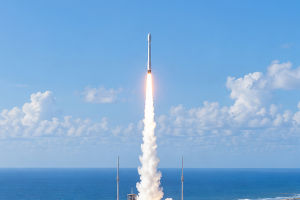
That helps explain why many major launch sites are located near coastlines. The ocean provides space for carefully managed flight paths, while the site's latitude and geography can make certain orbits easier to reach. But coastal locations also bring challenges, and not every rocket launches from the shore.
Earth's Rotation Can Give Rockets a Head Start
Earth rotates from west to east, carrying everything on its surface along with it. A rocket launching eastward can take advantage of that existing motion, reducing the additional speed it needs to reach certain orbits.
At Cape Canaveral in Florida, the ground moves eastward at approximately 1,470 kilometers per hour because of Earth's rotation. How much of that motion helps the rocket depends on its intended orbit and launch direction.
The benefit is greatest for suitable eastward launches from locations closer to the equator. However, not every spacecraft needs an eastward trajectory. Satellites heading into polar or sun-synchronous orbits often launch in other directions, even when that means receiving less help from Earth's rotation.
Open Water Provides Safer Flight Paths
One of the biggest advantages of a coastal launch site is the ability to direct rockets over relatively unpopulated ocean areas. During flight, a rocket may release boosters, protective fairings, or other hardware that must return to Earth.
Launch planners identify where debris could fall and establish safety zones to reduce risks to people, aircraft, and ships. An ocean flight path makes it easier to avoid densely populated areas, although the risks still require careful management.
Reusable rockets can also land on offshore platforms. SpaceX, for example, regularly lands Falcon 9 first stages on droneships positioned at sea. These boosters make controlled landings on the platforms rather than simply falling into the water for recovery.
Launch Sites Need Space Around Them
Rocket launches generate intense noise, heat, and powerful exhaust. Launch facilities therefore need to be separated from active pads and from areas where people live or work.
Coastal spaceports can provide useful buffer zones, especially when launch trajectories extend over the ocean. However, sound and vibration can still reach nearby communities, so location alone does not remove those concerns.
Florida's Kennedy Space Center and Cape Canaveral Space Force Station illustrate the importance of suitable land and established infrastructure. Their facilities include launch pads, assembly areas, transportation routes, and safety systems that support different kinds of missions.
Every Launch Requires Careful Safety Planning
Before a rocket lifts off, launch operators must account for its planned trajectory and the possible consequences of a malfunction. This includes coordinating temporary restrictions in nearby airspace and designated ocean areas.
Flight safety systems are designed to limit danger if a rocket travels outside acceptable conditions. Depending on the vehicle, these systems may operate automatically or involve ground-based personnel.
Coastal launch sites such as Europe's spaceport in French Guiana and Japan's Tanegashima Space Center benefit from having suitable flight paths over water. Their locations help operators manage risks, but every launch still requires detailed preparation and coordination.
Coastal Locations Have Their Own Challenges
Operating beside the sea is not always convenient. Salt-laden air can accelerate corrosion, requiring regular inspection and maintenance of launch structures and equipment.
Weather is another concern. Lightning, strong winds, and storms can delay launches, particularly in regions with rapidly changing conditions.
Geography also limits which directions are practical. Florida is well suited to many eastward launches, but reaching high-inclination or polar orbits can be more difficult because some trajectories would pass over populated areas.
Vandenberg Space Force Base in California offers a different advantage: its position on the Pacific coast allows rockets to travel southward over the ocean, making it particularly useful for polar and sun-synchronous missions.
Inland Launch Sites Still Have a Role
Not every spaceport needs an ocean nearby. Baikonur Cosmodrome in Kazakhstan and Jiuquan Satellite Launch Center in China are major examples of inland launch facilities.
These sites use designated flight corridors and landing areas to manage the risks associated with falling rocket hardware. Their locations reflect a combination of geography, history, infrastructure, and national space programs.
Inland launches can present additional challenges when flight paths pass near inhabited regions, so careful planning and safety measures remain essential.
Ultimately, the best location depends on the missions a spaceport must support. A coastline can offer important advantages, but it is one part of a much larger engineering and safety decision.
Coastal launch sites are common because they offer practical advantages, especially safer flight paths over open water and suitable directions for reaching orbit. Earth's rotation can provide an additional benefit for certain missions, while established infrastructure and surrounding buffer areas help support launch operations. Yet the ocean does not eliminate risk, and coastal facilities must contend with weather, corrosion, and geographical limits.